{% youtube 8tebhx0cCoU %}
Multi-Tenant SaaS Architecture: Scaling E-Commerce Without Breaking Isolation
Building a platform where thousands of merchants operate independently, yet share the same infrastructure, is one of modern software engineering's most elegant challenges. The wrong design choice early on can either waste resources serving empty capacity or become a security nightmare where tenant data bleeds across boundaries. This is why multi-tenant SaaS architecture, particularly in e-commerce, demands careful thought about isolation strategies that don't sacrifice efficiency.
Architecture Overview
A multi-tenant e-commerce platform like Shopify sits at the intersection of three critical concerns: merchant isolation, resource efficiency, and scalability. The architecture typically consists of a shared gateway layer that routes requests to tenant-specific instances, a database tier that separates data logically or physically, a shared services layer for common functionality like payments and shipping integrations, and independent storefront and admin applications for each merchant.
The key insight is strategic sharing. Rather than spinning up entirely separate infrastructure for each tenant (which would be prohibitively expensive), you build a shared foundation with isolated access patterns. The API gateway becomes your first line of defense, understanding which tenant is making a request and ensuring they only access their own resources. Behind that, the tenant context flows through every layer, acting as a security boundary that prevents data leakage even in shared compute environments.
Design decisions here prioritize both security and cost. You'll typically see a hybrid approach: some tables in the shared database use tenant ID as a partition key, allowing one physical database to serve multiple merchants. Other data, like financial records or highly sensitive customer information, might live in tenant-specific databases. Analytics and reporting systems often fan out data into a separate warehouse, transforming raw events into aggregated insights that respect tenant boundaries. The storefront and admin layers themselves are usually templated applications, deployed as containerized instances that pull their configuration and data based on the tenant identifier baked into their runtime.
Design Insight: The Data Isolation Paradox
Here's the tension every multi-tenant architect must resolve: complete isolation (separate database per tenant) is secure but expensive, while complete sharing (one table for all tenants) is efficient but risky. The answer lies in logical isolation with physical optionality. Design your data access layer so every query automatically filters by tenant ID, making isolation a code-level guarantee rather than an infrastructure bet. This means a query bug can't expose another merchant's data because the tenant context is enforced at the ORM or API layer, not just the database permissions level.
For efficiency, use a row-level security model in your primary database, where one schema serves all tenants but queries are scoped to WHERE tenant_id = current_tenant. Pair this with tiered data: high-value or sensitive data (transactions, customer profiles) lives in isolated databases provisioned per tenant or tenant group, while operational data (product catalogs, order metadata) shares the main instance. This hybrid approach gives you the security properties of isolation without the cost overhead. Tools like InfraSketch help visualize where these boundaries actually live in your system, making it easier to spot isolation gaps before they become incidents.
Watch the Full Design Process
See how this architecture comes together in real-time as we design it from first principles:
Try It Yourself
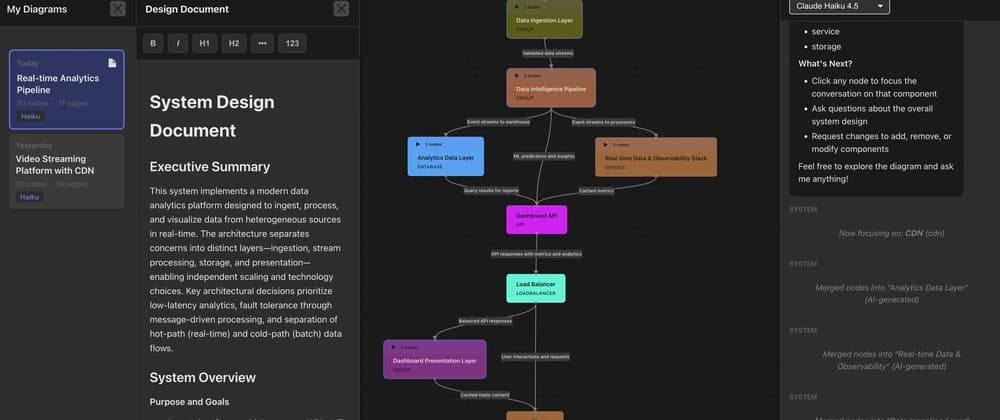
This is Day 22 of a 365-day system design challenge, and each day brings new architectural problems to solve. The next time you're designing a multi-tenant system, skip the whiteboard struggle. Head over to InfraSketch and describe your system in plain English. In seconds, you'll have a professional architecture diagram, complete with a design document that captures your isolation strategy, scaling approach, and component interactions.